

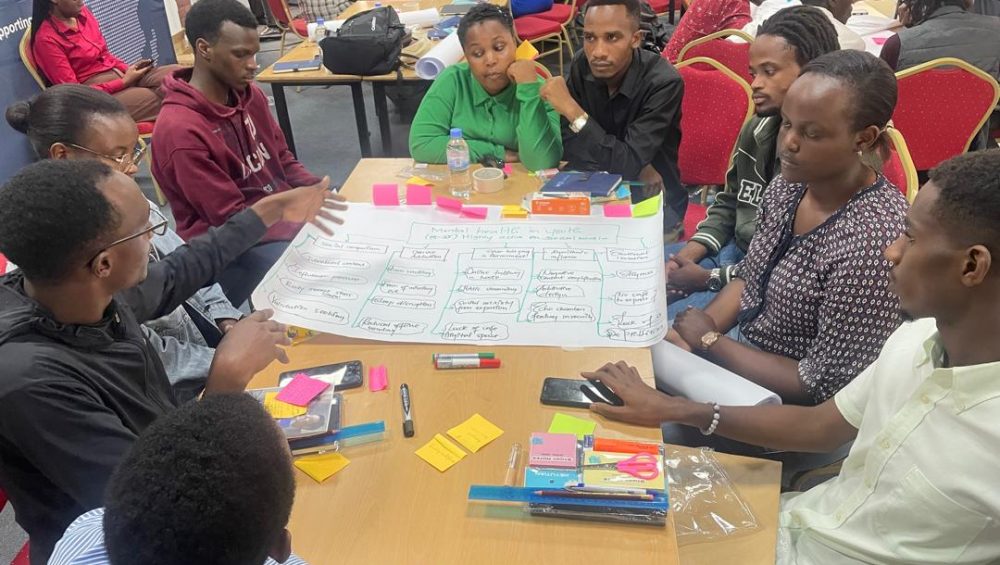
As conversations around youth mental health continue to grow globally, young innovators in Rwanda are increasingly stepping forward with technology-driven solutions designed to address the challenges facing their generation. This spirit of innovation and social impact was at the center of the UNLEASH Hack Rwanda 2025, a two-day innovation sprint focused on developing digital solutions for youth mental health and wellbeing.
Organized by UNIPOD Rwanda under the Timbuktoo Initiative powered by United Nations Development Programme in collaboration with UNLEASH, the event brought together 29 young innovators from universities across Rwanda under the theme: Digital Minds for Youth Mental Health & Wellbeing.
Held on June 20–21, 2025, the hackathon created a collaborative environment where participants applied design-thinking methodologies to explore one of the most pressing issues affecting young people today — mental health in the digital age. Guided by the internationally recognized UNLEASH Innovation Methodology, participants worked in multidisciplinary teams to identify root causes, frame meaningful challenges, and develop practical digital solutions with real-world impact potential.
The event was facilitated by a team of trained facilitators — Joyeux Shalom, Benitha Irakoze, and Peace Ndoli — who supported participants throughout the ideation and innovation process. Their guidance helped teams navigate problem analysis, empathy-building exercises, rapid prototyping, and solution pitching.
The first day of the hackathon focused on problem framing and root cause analysis. Participants engaged in user-centered research activities designed to better understand the realities of youth mental health challenges within the Rwandan context. Using tools such as Problem Trees and Root Cause Analysis frameworks, teams explored the underlying causes of depression, social media addiction, stress, and emotional isolation among young people. By the end of the day, each team had developed a clearly defined problem statement grounded in real experiences and community needs.
On the second day, participants transitioned into ideation, prototyping, and pitching. Teams brainstormed innovative approaches, selected viable concepts, and developed low-fidelity prototypes ranging from digital platform mockups to AI-powered wellness applications. With mentorship and collaborative feedback, participants refined their ideas and delivered final presentations to a judging panel.
Among the standout innovations was the winning project, Turikumwe Initiative, which addressed depression among young women aged 13–25 in Rwanda. The initiative proposed a hybrid support system combining school outreach programs with a digital platform that connects users to mental health professionals, peer communities, and inspirational recovery stories. The solution emphasized safe spaces, emotional support, and accessible mental health resources for vulnerable youth.
The first runner-up, Avisa, focused on combating the mental health effects of excessive social media usage. The platform functions as a digital wellness assistant capable of monitoring user behavior, detecting mood changes, and encouraging healthier digital habits through reminders and wellbeing prompts. By promoting self-awareness and balanced technology usage, the solution aimed to help young people regain control over their mental wellbeing.
Meanwhile, the second runner-up project, Nzaba Fine, introduced an AI-powered web and mobile application designed to support university students experiencing depression and emotional stress. The platform uses mood-based interactions, personalized prompts, and peer support communities to create a safe and engaging environment where users can access emotional support and connect with mental health professionals.
Beyond the competition itself, the UNLEASH Hack Rwanda 2025 demonstrated the growing capacity of Rwanda’s youth innovation ecosystem to address social challenges through empathy-driven technology and collaborative problem-solving. The event highlighted the importance of creating platforms where young people can transform lived experiences into actionable solutions capable of generating meaningful social impact.
The hackathon also reinforced the role of innovation ecosystems such as UniPod in empowering students and young innovators with the tools, mentorship, and collaborative spaces needed to experiment, prototype, and develop scalable ideas. By connecting technology, mental health awareness, and entrepreneurship, the initiative contributed to broader conversations around inclusive innovation and youth-led development in Rwanda.
As Rwanda continues to strengthen its position as a regional hub for innovation and technology, initiatives like UNLEASH Hack Rwanda 2025 serve as a reminder that some of the most impactful solutions emerge when young people are given the opportunity to collaborate, innovate, and lead change within their communities.